Looking Through
the Kaleidoscope
School Leadership and
Place-Based Change
Dr Vanessa Ogden CBE
October 2024
The kaleidoscope
Good school leaders are context-responsive, reflexive and sensitive.1 To be successful, they need to see and understand the complexity of their schools, the communities they serve and their schools’ connections to the places in which they are situated. Every ‘place’ has its own character, governed by wealth, class, identity and the life experience of the people who live there. There are many different perceptions of life, influenced by national social, economic, and political trends as well as local issues. These interplay constantly with aspects of identity such as ethnicity, class, gender, disability, sexuality, faith, and culture. There is a global dimension too, in that World Wide Web-based IT makes it possible to see into many different worlds and to cross time and space instantly. Through technology, you can know what is happening everywhere, all the time, all at once and so the lived experience of each person is in a context of super-complexity.2
For school leaders seeking to understand their schools and the dynamic contexts they are in, it is like looking into a large kaleidoscope with multiple different lenses. You must turn it this way and that, looking at every different angle of the social fabric of your school community, viewing a variety of configurations in pattern and texture. And you do it again and again as the context shifts, community perceptions change and your response to what you are seeing needs to alter accordingly.
Looking through this kaleidoscope and interpreting accurately what you see is essential for a school leader. The more challenging and complex your school’s context, the more nuanced and informed you must be to lead successfully. Different parts of your school community require different responses at different times as the social environment continuously evolves. It is why place matters in education – and why context-responsive leadership of place is so important.
Good school leaders are context-responsive, reflexive and sensitive.
Schools and place
School leaders whose schools are successful tend to develop a deep connection with the ‘place’ and the community which they serve. The bonds with people – students, their families, school staff, community leaders and local institutions – grow strong over time as you strive together in collective support of all the children you have care of. Many invisible hands are involved in the shaping of a child’s educational journey.
A good metaphor for this is the fiftieth anniversary tapestry at one of our Mulberry Schools Trust schools. It was designed by students to represent what a Mulberry girl is, because of her education. We took the design and the looms to our partner schools, service organisations, the local hospital, the local authority and many others in our community who, together with teachers, support staff, parents/carers, governors, and students of the school, had a hand in their education. All those hands wove the tapestry. The beauty of the finished piece reflects the school’s and its community’s collective journey alongside every Mulberry girl to support her ‘becoming’ – at graduation, she is the embodiment of all these different educational influences in the final outcome.
Your work as a school leader is highly relational. Over time, you encounter thousands of different existential moments connected to school in other people’s lives – and they all matter, regardless of how small or big they are. Where there are specific challenges, such as poverty or social exclusion, your reach into the community can be long. You interact with all kinds of different services – housing, immigration, social care, hospitals, food banks, mental health services, education departments and community support networks.
The quality of pastoral care and safeguarding at school are critical in such contexts. Whilst curriculum and qualifications are key, nurture, support for learning and physical, spiritual, moral, social and cultural development are essential too. Children need to come to class ‘ready to learn’, which can require extensive support to remove barriers. To do this, you build many different relationships – principally with parents or carers but also with the local authority and other local service providers. It is super-complex work and understanding your community is central.
Your work as a school leader is highly relational. Over time, you encounter thousands of different existential moments connected
to school in other people’s lives – and they all matter.
In my work, I see this every day. I have been a school leader in Tower Hamlets, East London, for 18 years. I often walk between the schools for which I am responsible as CEO in our multi-academy trust. Although the schools are within a few square miles of each other, those walks are all quite different. I love these different places and the contexts they represent, and I am always moved by the leaders of those schools and the way in which they calibrate so sensitively their approaches to education in line with their place.
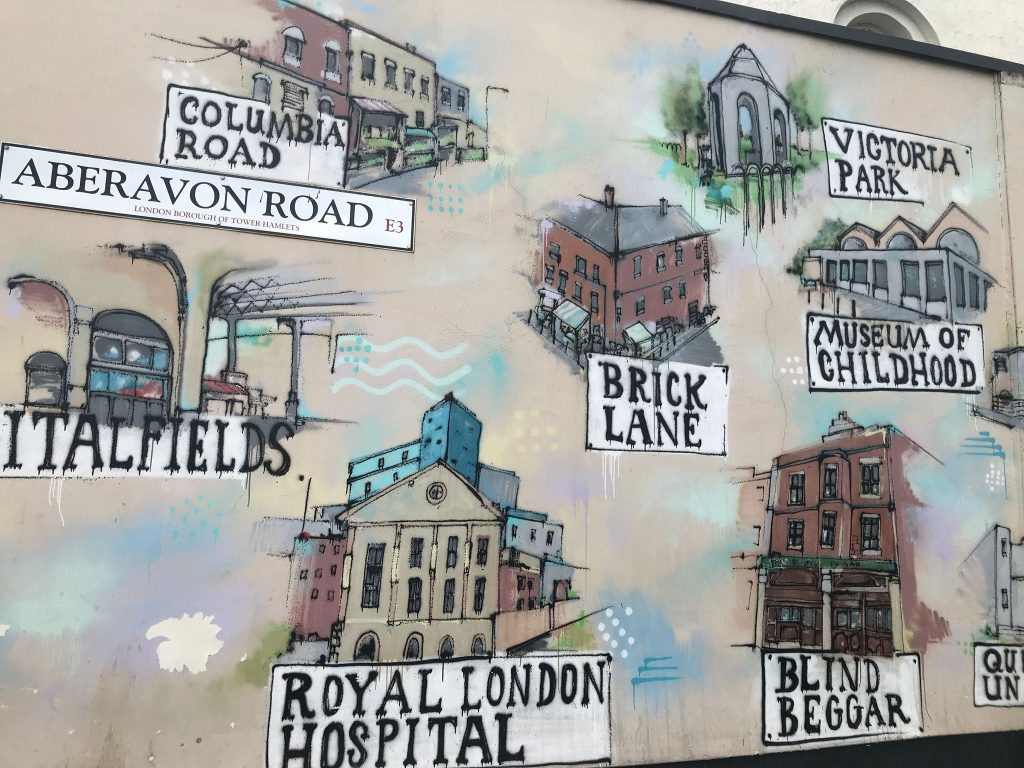
There’s the early morning walk to one of those schools along Bethnal Green Road from Shoreditch High Street, with its sleeping pop-up shops – trendy shabby chic vintage stores and vinyl record treasure troves line the route, alongside poetry cafés and Lady Dinah’s Cat Emporium where you can have afternoon tea with cats, the cats in the window either asleep, washing, or looking superior as you pass by. This part of London doesn’t rise until 10am at the earliest but it pulses late into the night. The school sits within estates of small flats belonging to the local authority, with scattered enclaves of arty and bohemian residences – Columbia Road and the cottages where TV crews can be found filming authentic locations for Victorian dramas.
Then there’s the afternoon walk down Brick Lane from Bethnal Green Road to another of the schools in Shadwell. You pass the beigel shops, The Truman Brewery, the Brick Lane Book Shop, graffiti art, and the Brick Lane Mosque – historically also a church and synagogue – reflecting the movement in of different communities of people because of persecution, economic migrancy or pursuit of better education. The air is full of spices from the curry houses that line the lane, with road signs in Bengali as well as English, reflecting the cultural fusion of the area. Turning into the Whitechapel Road, you can find the first public library – now a public art gallery – built by Victorian philanthropists for the residents of the slums at the turn of the twentieth century. Passing the East London Mosque along Whitechapel Road, the ethereal sound of the call to prayer in the golden-red autumn sunset is deeply moving.
Walking on from Whitechapel to the next school in Stepney, you pass by the Royal London Hospital, which was a beacon of hope during the Covid-19 pandemic in 2020 and 2021, its dedicated staff (many from the local community and alumni from our schools) burning the candle at both ends for those struggling to live. Bereavement affected many of our families at that terrible time. The pandemic drew open the curtains on the underlying issues for families of hunger, housing, and health poverty; issues which our schools, for so long, had been mitigating. However, on an early spring morning walk to the school, there is little sense of this extremity. You walk through streets lined with flats and little squares, like Albert Square in Eastenders, with small green spaces for leisure – I often encounter parents who greet me.3 When you pass Stepney Park in the early morning sunshine, you can hear the roosters crowing and the sheep bleating at Stepney City Farm, as the church on Stepney Green emerges from the mist. It is almost village life – almost rural in feel yet with housing in flats, surrounded by the tall buildings of inner-city urban life, the Canary Wharf skyline in the background.
These journeys remind me constantly of the super-complexity of context in school leadership – and why, despite being so close to each other, each of the schools is quite different. There are many similarities in their socio-economic and cultural character because of their geography. Child poverty is one, with disadvantage running high across our family of schools and many students living in over-crowded social housing. Faith is another, with Islam featuring strongly across our community along with diversity of ethnicity. There are other commonalities such as local business infrastructure, with better paid jobs going largely to non-residents. However, the feel of the place where each school is situated is different also because of complex local dynamics.
For example, Shoreditch has an edgy energy. Below the surface, there is an underworld of recreational drugs and nightlife into which young people can be drawn, and so schools must work hard to keep the tensions out and to channel the adrenalin into constructive, purposeful activity for students. For this reason, enrichment and after-school provision are extensive and pastoral care and safeguarding are a top priority. Children need the support of trusted adults who see them every day and know when things aren’t right.
Children need the support of trusted adults who see them every day and know when things aren’t right.
In such a context, every encounter with an adult must be positive because, for some, it may be the only affirmative experience a child may have that day. The headteacher and staff of our Shoreditch school are hard-wired to this need to know their students’ home environments well, switching up or down their responses according to an individual child’s needs in that moment. Some days a child may arrive unable to cope with a classroom setting because of what happened at home or on the street the night before. Being met at the door by a leader who can spot this and divert the child to alternative support avoids further trauma. When you visit the school, you see this in action every day.
Shadwell, behind Whitechapel Road, is different again. Wholesale shops and markets mean that at night the streets near the school are generally quiet, particularly following a police raid on organised crime in the area several years ago that saw several gang leaders given custodial sentences. Pastoral care is strong at the school, alongside home liaison and opportunities for parents’/carers’ involvement in the life of the school through social activity, classes and workshops on health or access to services. There is a children’s centre on the school site. During the Covid-19 lockdown, the school ran a foodbank with personal care essentials serving 520 families who needed support because they were hungry and struggling to find basic hygiene goods, such as sanitary towels and nappies. The drive of the school is to build economic autonomy, confidence, voice, and visibility for students and families, through opening opportunities to big local employers, universities and youth conference platforms for self-expression, such as MUN (Model United Nations). Provision is tailored and focused on equipping students to have the power of choice in life beyond the school.
At Stepney, the long-term focus of the school has been accessing graduate jobs through high standards of teaching, extended opportunities in STEM (science, technology, engineering, and maths) subjects and destinations to degrees and degree apprenticeships. Situated between two of the most affluent parts of London – the financial hub of the Docklands and the wealth of the City – residents in Stepney do not often benefit from this prosperity. Corporate employers and local health services have tended to recruit from outside the area for their higher-paid jobs. In the 1980s, the closure of industries related to shipping and printed newspapers changed the local economy, employment being either in graduate level work or low skills and gig economy occupations, with little in between. The drive of the headteacher is to bridge this for his students and their families. This includes seizing every opportunity to work closely with employers. A recent partnership in STEM with Mercedes-Benz Grand Prix Ltd exemplifies this. The programme includes supplementary teaching and qualifications, a range of workplace experiences, and the practical application of learning through designing and engineering race cars. The sixth form has grown under this leadership and university destinations for students, with their associated economic benefits, are a priority.
For many years, Ruth Lupton’s work has highlighted the intricate connections between schools, the places where they are and how they influence each other.4
Place shapes a school. Good schools tailor practice to suit the needs of students, their families, and the local community and therefore the emphasis of their work influences a school’s character and feel. For example, if not being able to speak English is a barrier for families, school leaders will prioritise support in school such as interpretation, help with homework in parent and child sessions, and services like advocacy, library workshops or language classes for parents and carers. A school leader might seek partnerships to help, such as with the National Literacy Trust.5
Place shapes a school. Good schools tailor practice to suit the needs of students, their families, and the local community.
Walking around a school is a semiotic experience: you will see the school’s priorities reflected in everything you see. Staff model the behaviours they expect. Displays celebrate work considered to be exemplary. Provision for enrichment, the offer for parents and carers, the curriculum, who to talk to for safeguarding – all the priorities of the school are visible and responsive to what the school community needs.
Equally, good schools shape the places they are in. Good schools act as community glue. They bring people together from a variety of backgrounds who otherwise might never meet. They bring additional resources to community life – either through sport, the arts, use of buildings by the community, access to local employers, festive celebrations, events, family learning programmes and so on. They build opportunities for their communities which, over time, can change the social fabric: reducing inequity and creating community cohesion.
Schools’ most powerful work leads to progress through place-based leadership that can be evidenced. For example, a 2023 report by the UK government’s Race Disparity Unit highlights the statistically significant progress of second-generation Bangladeshi men and women in the labour market compared with those of the first generation in Britain.6 The report links the success to education and improvements in health. In Tower Hamlets, home to many first and second-generation British Bangladeshis in the UK, there has been a track record of schools working closely with their families, the local authority, local communities and health partners to overcome financial disadvantage, inequality and health poverty.
A sustained, relentless focus on qualifications and standards of teaching by schools, supported by comprehensive inclusion services tailored for families, has seen strong progress in educational outcomes and employment over
time amongst younger Bangladeshi people. Since 2006, Tower Hamlets schools have been producing good or better outcomes for disadvantaged students, especially those of Bangladeshi background; they account for a significant proportion of the national cohort with these characteristics.7 As the latest Marmot review of health inequalities comments – place matters, whilst deprivation causes inequalities in life expectancy and the quality of lived experience; where you are poor makes a difference.8 How schools and local communities respond in a joined-up way to their circumstances is a significant factor in improvement and transformation.
School leadership and place-based change
The concept of place-based school leadership – where leaders join up community assets around their schools and collectively generate local transformation – is an important one for school improvement in our school system. It is not a coincidence that, having moved many schools out of local authority control to independence, multi-academy trusts have evolved to fill the gap in support. Leora Cruddas at the Confederation of School Trusts (CST) writes powerfully about school trusts as civic structures for leadership and improvement.9The original concept of place-based leadership in schools is not entirely new, although recently it has taken on a different flavour, characterised by localism and a growing argument for devolved power to regions. Two decades ago, ‘joined-up thinking’ and networked leadership were key components of centralised education policymaking under New Labour, as was early stage thinking about systemwide school leadership.
In 2003, the UK government set out a new policy, Every Child Matters, part of which was collecting around schools the local services that were additional to core provision. This included wraparound care, family learning, childcare and additional provision that could be targeted at need, such as speech and language therapy or social care. Called ‘Extended Schools’, the aim was to deal with poverty by opening schools for community use outside the usual school day in areas of most disadvantage and to have intersectoral work with child and family at the heart.
As a result, some school leaders became ‘network leaders’, allowing them a greater role in the system leading collective action for community regeneration. In some regions such as Tower Hamlets, this was formalised under Local Authority Partnerships, creating boards of representatives from local services and community assets, chaired by a headteacher. They met regularly to share information, join up thinking and support each other’s local work. Whilst this was not localism – it was a centralised government policy – nevertheless, it was a place-based response to disadvantage using schools as the community glue.
At the same time as Every Child Matters, the London Challenge 2002–2011 was launched as a place-based strategy focused on schools.10 Prior, London’s schools were the worst-performing of every region in England, despite big national interventions such as the National Literacy Strategy in 1998. Teacher vacancies were high and school leadership lacked capacity because London was unattractive as a place to teach. When the policy was implemented, gains were swift. In 2005, London equalled the national average achievement at GCSE and there were improvements in attendance as well as decreases in exclusions. Figurehead leadership led with a powerful call to arms for London’s children, drawing upon teachers’ sense of vocation and creating identification with the capital city as a unique and special place.
The policy’s successes were connected to practitioners’ buy-in to an inspiring, inclusive vision for London schools to which good teachers and school leaders could commit.11 Part of the challenge was to persuade Londoners to get behind their schools and their children. Visible improvement was important as well as raising awareness of success. Initiatives went as far as a London Underground – the ‘tube’ – publicity campaign in 2008, which celebrated London students’ GCSE results, advertising their achievements on the escalators, and publishing a special edition of the tube map replacing stations with the names of successful London schools in their locations.
The strategy was all about place. It was a systemwide approach to London schools which drew together:
extended school provision, situating in schools services that support children in need and their families
school to school support, with key London leaders stepping across the competitive divide to work shoulder to shoulder with schools that needed capacity to improve
published data on families of London schools, grouped by characteristics linked to place, so that leaders could find schools like theirs from which they could learn about improvement and share practice
interventions that improved quality of classroom practice. This included a cadre of 250 or more graduates from leading universities straight into London schools with significant levels of disadvantage. This was through Teach First with its mission to end education inequality in London.
Whilst the language was affirmative, the support given had a hard edge and was centrally managed by a highly effective, small team of key leaders and policy makers, who looked at data and local intelligence on school performance and brokered the work. It was monitored and was attached to grants to help fund the work. It was a ‘high challenge, high support’ model for school improvement, led by school leaders who were matched by the central team and held jointly accountable – the supporting head with the supported – for the outcomes, by contract. By the time the London Challenge ended, it had 12 successful intervention programmes, all led by serving headteachers.
81% of secondary schools and 41% of primary
schools became academies as of January 2023
Since the London Challenge, the school system has changed its structure in England. The National College of School Leadership was disbanded in 2013 and its inheritor, the National College of Teaching and Leadership, dissolved in 2018. Large numbers of schools have become academies – 81 per cent of secondary schools and 41 per cent of primary schools as of January 2023 – which are independent of local government.12 Many are joining groups of schools in the form of multi-academy trusts (MATs). Some MATs are collections of local schools. Other MATs have schools dispersed across England. From 2011 to 2022, London was split temporarily into three, and incorporated into other regions to support school improvement in the surrounding counties. The school system became an ecology, with a fluid character, much looser connectivity, and increasing independence from local authorities following the Academies Bill of 2010. Middle tier coordination of improvement support outside of multi-academy trusts is patchy across England and, where place is challenging and leadership is insufficient, some single academy trusts and schools have got into real difficulty.
In 2016, six Opportunity Areas (OAs) in cities were announced to improve schools in parts of England where standards remained stubbornly low.13 In 2017, the number was increased to twelve. Early independent evaluation in 2018 showed successes, particularly in school networks which pre-dated the policy, exciting local interest by partners to get together strategically around a set of educational priorities focused on place. In 2022, a further evaluation showed that although there were benefits to the OAs, there was less progress than expected.14 The Covid-19 pandemic, which created serious disruption to schools between 2020 and 2022, enabled some agile place-based responses to occur but planned outcomes for the OAs were damaged. In both evaluations, MATs were blamed as obstacles to joined-up work on place – interrupters of local connectivity, concentrating resources on their own schools. Another barrier cited was the lack of capacity and agency in local authorities and community services caused by the crisis and defunding.
Further efforts by the UK government to focus policymaking on place came through the ‘Levelling Up’ White Paper of 2022, an ambitious step concerned with tackling geographical disparities and social mobility, spreading opportunity more equally.15 Plans for improvement were centred on economic and social infrastructure covering all government departments. Education was only a part of the plan. Some reforms of the school system were made, for example to refocus the commissioning of new school provision and MAT growth, making locality – or place – a key consideration in such decisions.16 Under Levelling Up, the OAs became Education Investment Areas (EIAs) and the number of targeted regions increased from 12 to 55. However, generally, Levelling Up made little difference to policymaking for schools, which remained centralised, and uncalibrated to local context.
The interplay between centralisation and localism is interesting in all these policies for school improvement. Whilst they take account of place, with the notable exception of the London Challenge, they have had limited success. Since the 1944 Education Act which enshrined local control of schools, England has moved towards increasingly highly centralised organisation of the education system. Policymaking remains top-down and is largely distant to place, with the notable exception of the London Challenge. The introduction of regional advisory boards, which take account of an area’s school dynamics, helps to join up local knowledge at the Department for Education, but their potential to catalyse place-based school improvement is yet undeveloped. The gap has left space into which school leaders, and other social actors, have stepped independently, using their agency entrepreneurially to generate change. This has led to a growing number of place-based change initiatives in the UK. They are not centrally driven, and they are largely practitioner-led, often characterised by
collective action between business, the third sector and the public sector.
Those involved cite a deep knowledge of context as an essential starting point. Other key elements of success in these initiatives include:
co-creation of interventions by communities and institutions
input of expert practitioners which builds leadership capacity and development
a commitment to collective action and shared responsibility for the outcomes
inclusion, equity and social cohesion at the heart of all activity.
The Fair Education Alliance (FEA) is a UK charity which works towards closing the achievement gaps between students who are disadvantaged and their more advantaged peers.17 Funded by businesses, philanthropists and trusts, the FEA brings public, private and civil society organisations together to support schools and their families in areas of England with significant levels of disadvantage. Recently, the FEA has designed a digital tool which makes visible what is happening in different places across the country, allowing school leaders to find organisations with which they can engage on a specific issue, such as breakfast clubs, tutoring or school-home support. It also allows third sector organisations, businesses and public services to find places where schools might benefit from their offer. It’s a powerful engine for joining up support around schools and igniting leaders’ agency in place-based change, simply because the tool makes it so much easier to see and connect.
In other places, some of the metropolitan mayors are active in education and place-based change. Whilst they have no responsibility for schools, they recognise their agency in this is important. In the Liverpool City Region Combined Authority, Mayor Steve Rotheram is using his convening powers to create an education strategy for tackling low standards, particularly where disadvantage has been an intransigent problem.18 There is a multi-sector approach to the issues, led by his policy team and involving civil society organisations such as Right to Succeed.19 Big local players such as Everton and Liverpool football clubs, public services including the Liverpool John Moores University, and social business and enterprise organisations like Kindred, have joined in to support the drive to raise standards in schools, improve skills and increase social mobility.20
Communities must be given the resources and the responsibility to make change happen over the long term.
Some school leaders in the UK have been working on place-based change in different ways. Reconnect London arose during the Covid-19 pandemic in response to its impact on our most disadvantaged children, reconnecting school leaders across the London system at a time of fragmentation.21 It continues its work to bring maintained and academy schools together in support of each other, highlighting context-responsive work centred on place.22 Reach Academy Feltham is another example.23 Ark Academy Trust has established ‘Ark Ventures’, social enterprises that join up much needed services around its schools.24 Mulberry Changemaker programmes take an entrepreneurial approach to addressing some of the ‘wicked problems’ which have held back disadvantaged students from ethnic minority backgrounds.
The rise in individuals and organisations stepping in to generate place-based change is not confined to the UK. Internationally, the Tamarack Institute in Canada has been working successfully since 2001 on place-based change and disadvantage.25 Its aims are to document and disseminate exemplary practice in collective action and community change and to apply what has been learned to end poverty. In Australia and New Zealand, there is a raft of similar work. Whilst the work is not centred in education, there is learning which can be applied. A recent paper from four organisations focused on place-based approaches to dealing with inequity – Tamarack, Place Matters in the UK, Collaboration for Impact in Australia, and Inspiring Communities in New Zealand – identified several important components that characterise their initiatives despite differences in the way they practice:
Equity is a foundational principle that must be embedded.
Communities must be given the resources and the responsibility to make change happen over the long term.
There must be a system of support, professional development, and capacity building to accelerate the scale of place-based change.
Place-based change work is longitudinal and takes time.
The national infrastructure must enable and support place-based change.26
It is significant that these international studies show similar findings to those in the UK. Collectively, their argument is that smaller units of place-based change are more likely to be successful in dealing with intractable issues of disadvantage than big, top-down policy initiatives which – by their very nature – don’t properly understand or reach the complexity of a local community. To transform the impact of poverty on disadvantaged young people in schools, they acknowledge the importance of local leadership in local contexts with longitudinal intervention, within an education policy framework that supports and resources this work effectively.
Equity is a foundational principle that must be embedded.
Place matters
Good school leaders have a kaleidoscopic knowledge of context and are in a strong position to lead transformation in areas where disadvantage is a stubborn problem. They join up thinking and planning. They are entrepreneurial. They act in a spirit of reciprocity, respecting community knowledge and valuing local people. They know that capacity building and long-term commitment are necessary to initiate sustained – and sustainable – change. Where this happens collectively in an organised, long-term, and intentional way, focused on place, there is evidence of improved outcomes. Marmot’s point – where you are poor makes a big difference – is profound.
A progressive government, when making education policy, must see the considerable benefits of school leadership of place. Schools – and families of schools – are community glue. They are important catalysts of change and school leaders could be resourced better to deal with the wider issues in poverty and disadvantage affecting children in their communities. It is an argument for creating an education policy infrastructure that recognises pluralism, builds on localism, and understands the intricate connection of schools with their place – a policy infrastructure that:
acknowledges the power of smaller units of change within the wider school system, equipping trusts and school leaders to deliver on place-based change through community hubs, and holding them accountable for this
gives incentives for collective action amongst public, corporate, university and civil society partners for schools specifically in areas of disadvantage
recognises the importance of resourcing longitudinal interventions that build capacity amongst local leaders to generate sustained – and sustainable – community change
puts at its heart the significance of contextual knowledge, listening effectively to plural voices and ensuring that equity and inclusion are central considerations.
Place matters in education – and it’s why context-responsive school leadership, supported by a policy framework that makes the most of this asset, is just so important.
Good school leaders have a kaleidoscopic knowledge of context and are in a strong position to lead transformation in areas where disadvantage is a stubborn problem.
We use cookies to ensure that we give you the best experience on our website. If you continue to use this site we will assume that you are happy with it.


 For school leaders seeking to understand their schools and the dynamic contexts they are in, it is like looking into a large kaleidoscope with multiple different lenses. You must turn it this way and that, looking at every different angle of the social fabric of your school community, viewing a variety of configurations in pattern and texture. And you do it again and again as the context shifts, community perceptions change and your response to what you are seeing needs to alter accordingly.
Looking through this kaleidoscope and interpreting accurately what you see is essential for a school leader. The more challenging and complex your school’s context, the more nuanced and informed you must be to lead successfully. Different parts of your school community require different responses at different times as the social environment continuously evolves. It is why place matters in education – and why context-responsive leadership of place is so important.
Good school leaders are context-responsive, reflexive and sensitive.
For school leaders seeking to understand their schools and the dynamic contexts they are in, it is like looking into a large kaleidoscope with multiple different lenses. You must turn it this way and that, looking at every different angle of the social fabric of your school community, viewing a variety of configurations in pattern and texture. And you do it again and again as the context shifts, community perceptions change and your response to what you are seeing needs to alter accordingly.
Looking through this kaleidoscope and interpreting accurately what you see is essential for a school leader. The more challenging and complex your school’s context, the more nuanced and informed you must be to lead successfully. Different parts of your school community require different responses at different times as the social environment continuously evolves. It is why place matters in education – and why context-responsive leadership of place is so important.
Good school leaders are context-responsive, reflexive and sensitive.



 Your work as a school leader is highly relational. Over time, you encounter thousands of different existential moments connected
to school in other people’s lives – and they all matter.
In my work, I see this every day. I have been a school leader in Tower Hamlets, East London, for 18 years. I often walk between the schools for which I am responsible as CEO in our multi-academy trust. Although the schools are within a few square miles of each other, those walks are all quite different. I love these different places and the contexts they represent, and I am always moved by the leaders of those schools and the way in which they calibrate so sensitively their approaches to education in line with their place.
There’s the early morning walk to one of those schools along Bethnal Green Road from Shoreditch High Street, with its sleeping pop-up shops – trendy shabby chic vintage stores and vinyl record treasure troves line the route, alongside poetry cafés and Lady Dinah’s Cat Emporium where you can have afternoon tea with cats, the cats in the window either asleep, washing, or looking superior as you pass by. This part of London doesn’t rise until 10am at the earliest but it pulses late into the night. The school sits within estates of small flats belonging to the local authority, with scattered enclaves of arty and bohemian residences – Columbia Road and the cottages where TV crews can be found filming authentic locations for Victorian dramas.
Then there’s the afternoon walk down Brick Lane from Bethnal Green Road to another of the schools in Shadwell. You pass the beigel shops, The Truman Brewery, the Brick Lane Book Shop, graffiti art, and the Brick Lane Mosque – historically also a church and synagogue – reflecting the movement in of different communities of people because of persecution, economic migrancy or pursuit of better education. The air is full of spices from the curry houses that line the lane, with road signs in Bengali as well as English, reflecting the cultural fusion of the area. Turning into the Whitechapel Road, you can find the first public library – now a public art gallery – built by Victorian philanthropists for the residents of the slums at the turn of the twentieth century. Passing the East London Mosque along Whitechapel Road, the ethereal sound of the call to prayer in the golden-red autumn sunset is deeply moving.
Your work as a school leader is highly relational. Over time, you encounter thousands of different existential moments connected
to school in other people’s lives – and they all matter.
In my work, I see this every day. I have been a school leader in Tower Hamlets, East London, for 18 years. I often walk between the schools for which I am responsible as CEO in our multi-academy trust. Although the schools are within a few square miles of each other, those walks are all quite different. I love these different places and the contexts they represent, and I am always moved by the leaders of those schools and the way in which they calibrate so sensitively their approaches to education in line with their place.
There’s the early morning walk to one of those schools along Bethnal Green Road from Shoreditch High Street, with its sleeping pop-up shops – trendy shabby chic vintage stores and vinyl record treasure troves line the route, alongside poetry cafés and Lady Dinah’s Cat Emporium where you can have afternoon tea with cats, the cats in the window either asleep, washing, or looking superior as you pass by. This part of London doesn’t rise until 10am at the earliest but it pulses late into the night. The school sits within estates of small flats belonging to the local authority, with scattered enclaves of arty and bohemian residences – Columbia Road and the cottages where TV crews can be found filming authentic locations for Victorian dramas.
Then there’s the afternoon walk down Brick Lane from Bethnal Green Road to another of the schools in Shadwell. You pass the beigel shops, The Truman Brewery, the Brick Lane Book Shop, graffiti art, and the Brick Lane Mosque – historically also a church and synagogue – reflecting the movement in of different communities of people because of persecution, economic migrancy or pursuit of better education. The air is full of spices from the curry houses that line the lane, with road signs in Bengali as well as English, reflecting the cultural fusion of the area. Turning into the Whitechapel Road, you can find the first public library – now a public art gallery – built by Victorian philanthropists for the residents of the slums at the turn of the twentieth century. Passing the East London Mosque along Whitechapel Road, the ethereal sound of the call to prayer in the golden-red autumn sunset is deeply moving.


 Walking on from Whitechapel to the next school in Stepney, you pass by the Royal London Hospital, which was a beacon of hope during the Covid-19 pandemic in 2020 and 2021, its dedicated staff (many from the local community and alumni from our schools) burning the candle at both ends for those struggling to live. Bereavement affected many of our families at that terrible time. The pandemic drew open the curtains on the underlying issues for families of hunger, housing, and health poverty; issues which our schools, for so long, had been mitigating. However, on an early spring morning walk to the school, there is little sense of this extremity. You walk through streets lined with flats and little squares, like Albert Square in Eastenders, with small green spaces for leisure – I often encounter parents who greet me.3 When you pass Stepney Park in the early morning sunshine, you can hear the roosters crowing and the sheep bleating at Stepney City Farm, as the church on Stepney Green emerges from the mist. It is almost village life – almost rural in feel yet with housing in flats, surrounded by the tall buildings of inner-city urban life, the Canary Wharf skyline in the background.
These journeys remind me constantly of the super-complexity of context in school leadership – and why, despite being so close to each other, each of the schools is quite different. There are many similarities in their socio-economic and cultural character because of their geography. Child poverty is one, with disadvantage running high across our family of schools and many students living in over-crowded social housing. Faith is another, with Islam featuring strongly across our community along with diversity of ethnicity. There are other commonalities such as local business infrastructure, with better paid jobs going largely to non-residents. However, the feel of the place where each school is situated is different also because of complex local dynamics.
For example, Shoreditch has an edgy energy. Below the surface, there is an underworld of recreational drugs and nightlife into which young people can be drawn, and so schools must work hard to keep the tensions out and to channel the adrenalin into constructive, purposeful activity for students. For this reason, enrichment and after-school provision are extensive and pastoral care and safeguarding are a top priority. Children need the support of trusted adults who see them every day and know when things aren’t right.
Children need the support of trusted adults who see them every day and know when things aren’t right.
In such a context, every encounter with an adult must be positive because, for some, it may be the only affirmative experience a child may have that day. The headteacher and staff of our Shoreditch school are hard-wired to this need to know their students’ home environments well, switching up or down their responses according to an individual child’s needs in that moment. Some days a child may arrive unable to cope with a classroom setting because of what happened at home or on the street the night before. Being met at the door by a leader who can spot this and divert the child to alternative support avoids further trauma. When you visit the school, you see this in action every day.
Shadwell, behind Whitechapel Road, is different again. Wholesale shops and markets mean that at night the streets near the school are generally quiet, particularly following a police raid on organised crime in the area several years ago that saw several gang leaders given custodial sentences. Pastoral care is strong at the school, alongside home liaison and opportunities for parents’/carers’ involvement in the life of the school through social activity, classes and workshops on health or access to services. There is a children’s centre on the school site. During the Covid-19 lockdown, the school ran a foodbank with personal care essentials serving 520 families who needed support because they were hungry and struggling to find basic hygiene goods, such as sanitary towels and nappies. The drive of the school is to build economic autonomy, confidence, voice, and visibility for students and families, through opening opportunities to big local employers, universities and youth conference platforms for self-expression, such as MUN (Model United Nations). Provision is tailored and focused on equipping students to have the power of choice in life beyond the school.
Walking on from Whitechapel to the next school in Stepney, you pass by the Royal London Hospital, which was a beacon of hope during the Covid-19 pandemic in 2020 and 2021, its dedicated staff (many from the local community and alumni from our schools) burning the candle at both ends for those struggling to live. Bereavement affected many of our families at that terrible time. The pandemic drew open the curtains on the underlying issues for families of hunger, housing, and health poverty; issues which our schools, for so long, had been mitigating. However, on an early spring morning walk to the school, there is little sense of this extremity. You walk through streets lined with flats and little squares, like Albert Square in Eastenders, with small green spaces for leisure – I often encounter parents who greet me.3 When you pass Stepney Park in the early morning sunshine, you can hear the roosters crowing and the sheep bleating at Stepney City Farm, as the church on Stepney Green emerges from the mist. It is almost village life – almost rural in feel yet with housing in flats, surrounded by the tall buildings of inner-city urban life, the Canary Wharf skyline in the background.
These journeys remind me constantly of the super-complexity of context in school leadership – and why, despite being so close to each other, each of the schools is quite different. There are many similarities in their socio-economic and cultural character because of their geography. Child poverty is one, with disadvantage running high across our family of schools and many students living in over-crowded social housing. Faith is another, with Islam featuring strongly across our community along with diversity of ethnicity. There are other commonalities such as local business infrastructure, with better paid jobs going largely to non-residents. However, the feel of the place where each school is situated is different also because of complex local dynamics.
For example, Shoreditch has an edgy energy. Below the surface, there is an underworld of recreational drugs and nightlife into which young people can be drawn, and so schools must work hard to keep the tensions out and to channel the adrenalin into constructive, purposeful activity for students. For this reason, enrichment and after-school provision are extensive and pastoral care and safeguarding are a top priority. Children need the support of trusted adults who see them every day and know when things aren’t right.
Children need the support of trusted adults who see them every day and know when things aren’t right.
In such a context, every encounter with an adult must be positive because, for some, it may be the only affirmative experience a child may have that day. The headteacher and staff of our Shoreditch school are hard-wired to this need to know their students’ home environments well, switching up or down their responses according to an individual child’s needs in that moment. Some days a child may arrive unable to cope with a classroom setting because of what happened at home or on the street the night before. Being met at the door by a leader who can spot this and divert the child to alternative support avoids further trauma. When you visit the school, you see this in action every day.
Shadwell, behind Whitechapel Road, is different again. Wholesale shops and markets mean that at night the streets near the school are generally quiet, particularly following a police raid on organised crime in the area several years ago that saw several gang leaders given custodial sentences. Pastoral care is strong at the school, alongside home liaison and opportunities for parents’/carers’ involvement in the life of the school through social activity, classes and workshops on health or access to services. There is a children’s centre on the school site. During the Covid-19 lockdown, the school ran a foodbank with personal care essentials serving 520 families who needed support because they were hungry and struggling to find basic hygiene goods, such as sanitary towels and nappies. The drive of the school is to build economic autonomy, confidence, voice, and visibility for students and families, through opening opportunities to big local employers, universities and youth conference platforms for self-expression, such as MUN (Model United Nations). Provision is tailored and focused on equipping students to have the power of choice in life beyond the school.
 At Stepney, the long-term focus of the school has been accessing graduate jobs through high standards of teaching, extended opportunities in STEM (science, technology, engineering, and maths) subjects and destinations to degrees and degree apprenticeships. Situated between two of the most affluent parts of London – the financial hub of the Docklands and the wealth of the City – residents in Stepney do not often benefit from this prosperity. Corporate employers and local health services have tended to recruit from outside the area for their higher-paid jobs. In the 1980s, the closure of industries related to shipping and printed newspapers changed the local economy, employment being either in graduate level work or low skills and gig economy occupations, with little in between. The drive of the headteacher is to bridge this for his students and their families. This includes seizing every opportunity to work closely with employers. A recent partnership in STEM with Mercedes-Benz Grand Prix Ltd exemplifies this. The programme includes supplementary teaching and qualifications, a range of workplace experiences, and the practical application of learning through designing and engineering race cars. The sixth form has grown under this leadership and university destinations for students, with their associated economic benefits, are a priority.
For many years, Ruth Lupton’s work has highlighted the intricate connections between schools, the places where they are and how they influence each other.4
Place shapes a school. Good schools tailor practice to suit the needs of students, their families, and the local community and therefore the emphasis of their work influences a school’s character and feel. For example, if not being able to speak English is a barrier for families, school leaders will prioritise support in school such as interpretation, help with homework in parent and child sessions, and services like advocacy, library workshops or language classes for parents and carers. A school leader might seek partnerships to help, such as with the National Literacy Trust.5
Place shapes a school. Good schools tailor practice to suit the needs of students, their families, and the local community.
At Stepney, the long-term focus of the school has been accessing graduate jobs through high standards of teaching, extended opportunities in STEM (science, technology, engineering, and maths) subjects and destinations to degrees and degree apprenticeships. Situated between two of the most affluent parts of London – the financial hub of the Docklands and the wealth of the City – residents in Stepney do not often benefit from this prosperity. Corporate employers and local health services have tended to recruit from outside the area for their higher-paid jobs. In the 1980s, the closure of industries related to shipping and printed newspapers changed the local economy, employment being either in graduate level work or low skills and gig economy occupations, with little in between. The drive of the headteacher is to bridge this for his students and their families. This includes seizing every opportunity to work closely with employers. A recent partnership in STEM with Mercedes-Benz Grand Prix Ltd exemplifies this. The programme includes supplementary teaching and qualifications, a range of workplace experiences, and the practical application of learning through designing and engineering race cars. The sixth form has grown under this leadership and university destinations for students, with their associated economic benefits, are a priority.
For many years, Ruth Lupton’s work has highlighted the intricate connections between schools, the places where they are and how they influence each other.4
Place shapes a school. Good schools tailor practice to suit the needs of students, their families, and the local community and therefore the emphasis of their work influences a school’s character and feel. For example, if not being able to speak English is a barrier for families, school leaders will prioritise support in school such as interpretation, help with homework in parent and child sessions, and services like advocacy, library workshops or language classes for parents and carers. A school leader might seek partnerships to help, such as with the National Literacy Trust.5
Place shapes a school. Good schools tailor practice to suit the needs of students, their families, and the local community.
 Walking around a school is a semiotic experience: you will see the school’s priorities reflected in everything you see. Staff model the behaviours they expect. Displays celebrate work considered to be exemplary. Provision for enrichment, the offer for parents and carers, the curriculum, who to talk to for safeguarding – all the priorities of the school are visible and responsive to what the school community needs.
Equally, good schools shape the places they are in. Good schools act as community glue. They bring people together from a variety of backgrounds who otherwise might never meet. They bring additional resources to community life – either through sport, the arts, use of buildings by the community, access to local employers, festive celebrations, events, family learning programmes and so on. They build opportunities for their communities which, over time, can change the social fabric: reducing inequity and creating community cohesion.
Schools’ most powerful work leads to progress through place-based leadership that can be evidenced. For example, a 2023 report by the UK government’s Race Disparity Unit highlights the statistically significant progress of second-generation Bangladeshi men and women in the labour market compared with those of the first generation in Britain.6 The report links the success to education and improvements in health. In Tower Hamlets, home to many first and second-generation British Bangladeshis in the UK, there has been a track record of schools working closely with their families, the local authority, local communities and health partners to overcome financial disadvantage, inequality and health poverty.
A sustained, relentless focus on qualifications and standards of teaching by schools, supported by comprehensive inclusion services tailored for families, has seen strong progress in educational outcomes and employment over
time amongst younger Bangladeshi people. Since 2006, Tower Hamlets schools have been producing good or better outcomes for disadvantaged students, especially those of Bangladeshi background; they account for a significant proportion of the national cohort with these characteristics.7 As the latest Marmot review of health inequalities comments – place matters, whilst deprivation causes inequalities in life expectancy and the quality of lived experience; where you are poor makes a difference.8 How schools and local communities respond in a joined-up way to their circumstances is a significant factor in improvement and transformation.
Walking around a school is a semiotic experience: you will see the school’s priorities reflected in everything you see. Staff model the behaviours they expect. Displays celebrate work considered to be exemplary. Provision for enrichment, the offer for parents and carers, the curriculum, who to talk to for safeguarding – all the priorities of the school are visible and responsive to what the school community needs.
Equally, good schools shape the places they are in. Good schools act as community glue. They bring people together from a variety of backgrounds who otherwise might never meet. They bring additional resources to community life – either through sport, the arts, use of buildings by the community, access to local employers, festive celebrations, events, family learning programmes and so on. They build opportunities for their communities which, over time, can change the social fabric: reducing inequity and creating community cohesion.
Schools’ most powerful work leads to progress through place-based leadership that can be evidenced. For example, a 2023 report by the UK government’s Race Disparity Unit highlights the statistically significant progress of second-generation Bangladeshi men and women in the labour market compared with those of the first generation in Britain.6 The report links the success to education and improvements in health. In Tower Hamlets, home to many first and second-generation British Bangladeshis in the UK, there has been a track record of schools working closely with their families, the local authority, local communities and health partners to overcome financial disadvantage, inequality and health poverty.
A sustained, relentless focus on qualifications and standards of teaching by schools, supported by comprehensive inclusion services tailored for families, has seen strong progress in educational outcomes and employment over
time amongst younger Bangladeshi people. Since 2006, Tower Hamlets schools have been producing good or better outcomes for disadvantaged students, especially those of Bangladeshi background; they account for a significant proportion of the national cohort with these characteristics.7 As the latest Marmot review of health inequalities comments – place matters, whilst deprivation causes inequalities in life expectancy and the quality of lived experience; where you are poor makes a difference.8 How schools and local communities respond in a joined-up way to their circumstances is a significant factor in improvement and transformation.


 At the same time as Every Child Matters, the London Challenge 2002–2011 was launched as a place-based strategy focused on schools.10 Prior, London’s schools were the worst-performing of every region in England, despite big national interventions such as the National Literacy Strategy in 1998. Teacher vacancies were high and school leadership lacked capacity because London was unattractive as a place to teach. When the policy was implemented, gains were swift. In 2005, London equalled the national average achievement at GCSE and there were improvements in attendance as well as decreases in exclusions. Figurehead leadership led with a powerful call to arms for London’s children, drawing upon teachers’ sense of vocation and creating identification with the capital city as a unique and special place.
The policy’s successes were connected to practitioners’ buy-in to an inspiring, inclusive vision for London schools to which good teachers and school leaders could commit.11 Part of the challenge was to persuade Londoners to get behind their schools and their children. Visible improvement was important as well as raising awareness of success. Initiatives went as far as a London Underground – the ‘tube’ – publicity campaign in 2008, which celebrated London students’ GCSE results, advertising their achievements on the escalators, and publishing a special edition of the tube map replacing stations with the names of successful London schools in their locations.
The strategy was all about place. It was a systemwide approach to London schools which drew together:
At the same time as Every Child Matters, the London Challenge 2002–2011 was launched as a place-based strategy focused on schools.10 Prior, London’s schools were the worst-performing of every region in England, despite big national interventions such as the National Literacy Strategy in 1998. Teacher vacancies were high and school leadership lacked capacity because London was unattractive as a place to teach. When the policy was implemented, gains were swift. In 2005, London equalled the national average achievement at GCSE and there were improvements in attendance as well as decreases in exclusions. Figurehead leadership led with a powerful call to arms for London’s children, drawing upon teachers’ sense of vocation and creating identification with the capital city as a unique and special place.
The policy’s successes were connected to practitioners’ buy-in to an inspiring, inclusive vision for London schools to which good teachers and school leaders could commit.11 Part of the challenge was to persuade Londoners to get behind their schools and their children. Visible improvement was important as well as raising awareness of success. Initiatives went as far as a London Underground – the ‘tube’ – publicity campaign in 2008, which celebrated London students’ GCSE results, advertising their achievements on the escalators, and publishing a special edition of the tube map replacing stations with the names of successful London schools in their locations.
The strategy was all about place. It was a systemwide approach to London schools which drew together:
 Further efforts by the UK government to focus policymaking on place came through the ‘Levelling Up’ White Paper of 2022, an ambitious step concerned with tackling geographical disparities and social mobility, spreading opportunity more equally.15 Plans for improvement were centred on economic and social infrastructure covering all government departments. Education was only a part of the plan. Some reforms of the school system were made, for example to refocus the commissioning of new school provision and MAT growth, making locality – or place – a key consideration in such decisions.16 Under Levelling Up, the OAs became Education Investment Areas (EIAs) and the number of targeted regions increased from 12 to 55. However, generally, Levelling Up made little difference to policymaking for schools, which remained centralised, and uncalibrated to local context.
The interplay between centralisation and localism is interesting in all these policies for school improvement. Whilst they take account of place, with the notable exception of the London Challenge, they have had limited success. Since the 1944 Education Act which enshrined local control of schools, England has moved towards increasingly highly centralised organisation of the education system. Policymaking remains top-down and is largely distant to place, with the notable exception of the London Challenge. The introduction of regional advisory boards, which take account of an area’s school dynamics, helps to join up local knowledge at the Department for Education, but their potential to catalyse place-based school improvement is yet undeveloped. The gap has left space into which school leaders, and other social actors, have stepped independently, using their agency entrepreneurially to generate change. This has led to a growing number of place-based change initiatives in the UK. They are not centrally driven, and they are largely practitioner-led, often characterised by
collective action between business, the third sector and the public sector.
Further efforts by the UK government to focus policymaking on place came through the ‘Levelling Up’ White Paper of 2022, an ambitious step concerned with tackling geographical disparities and social mobility, spreading opportunity more equally.15 Plans for improvement were centred on economic and social infrastructure covering all government departments. Education was only a part of the plan. Some reforms of the school system were made, for example to refocus the commissioning of new school provision and MAT growth, making locality – or place – a key consideration in such decisions.16 Under Levelling Up, the OAs became Education Investment Areas (EIAs) and the number of targeted regions increased from 12 to 55. However, generally, Levelling Up made little difference to policymaking for schools, which remained centralised, and uncalibrated to local context.
The interplay between centralisation and localism is interesting in all these policies for school improvement. Whilst they take account of place, with the notable exception of the London Challenge, they have had limited success. Since the 1944 Education Act which enshrined local control of schools, England has moved towards increasingly highly centralised organisation of the education system. Policymaking remains top-down and is largely distant to place, with the notable exception of the London Challenge. The introduction of regional advisory boards, which take account of an area’s school dynamics, helps to join up local knowledge at the Department for Education, but their potential to catalyse place-based school improvement is yet undeveloped. The gap has left space into which school leaders, and other social actors, have stepped independently, using their agency entrepreneurially to generate change. This has led to a growing number of place-based change initiatives in the UK. They are not centrally driven, and they are largely practitioner-led, often characterised by
collective action between business, the third sector and the public sector.
 Those involved cite a deep knowledge of context as an essential starting point. Other key elements of success in these initiatives include:


 Communities must be given the resources and the responsibility to make change happen over the long term.
Some school leaders in the UK have been working on place-based change in different ways. Reconnect London arose during the Covid-19 pandemic in response to its impact on our most disadvantaged children, reconnecting school leaders across the London system at a time of fragmentation.21 It continues its work to bring maintained and academy schools together in support of each other, highlighting context-responsive work centred on place.22 Reach Academy Feltham is another example.23 Ark Academy Trust has established ‘Ark Ventures’, social enterprises that join up much needed services around its schools.24 Mulberry Changemaker programmes take an entrepreneurial approach to addressing some of the ‘wicked problems’ which have held back disadvantaged students from ethnic minority backgrounds.
The rise in individuals and organisations stepping in to generate place-based change is not confined to the UK. Internationally, the Tamarack Institute in Canada has been working successfully since 2001 on place-based change and disadvantage.25 Its aims are to document and disseminate exemplary practice in collective action and community change and to apply what has been learned to end poverty. In Australia and New Zealand, there is a raft of similar work. Whilst the work is not centred in education, there is learning which can be applied. A recent paper from four organisations focused on place-based approaches to dealing with inequity – Tamarack, Place Matters in the UK, Collaboration for Impact in Australia, and Inspiring Communities in New Zealand – identified several important components that characterise their initiatives despite differences in the way they practice:
Communities must be given the resources and the responsibility to make change happen over the long term.
Some school leaders in the UK have been working on place-based change in different ways. Reconnect London arose during the Covid-19 pandemic in response to its impact on our most disadvantaged children, reconnecting school leaders across the London system at a time of fragmentation.21 It continues its work to bring maintained and academy schools together in support of each other, highlighting context-responsive work centred on place.22 Reach Academy Feltham is another example.23 Ark Academy Trust has established ‘Ark Ventures’, social enterprises that join up much needed services around its schools.24 Mulberry Changemaker programmes take an entrepreneurial approach to addressing some of the ‘wicked problems’ which have held back disadvantaged students from ethnic minority backgrounds.
The rise in individuals and organisations stepping in to generate place-based change is not confined to the UK. Internationally, the Tamarack Institute in Canada has been working successfully since 2001 on place-based change and disadvantage.25 Its aims are to document and disseminate exemplary practice in collective action and community change and to apply what has been learned to end poverty. In Australia and New Zealand, there is a raft of similar work. Whilst the work is not centred in education, there is learning which can be applied. A recent paper from four organisations focused on place-based approaches to dealing with inequity – Tamarack, Place Matters in the UK, Collaboration for Impact in Australia, and Inspiring Communities in New Zealand – identified several important components that characterise their initiatives despite differences in the way they practice:



 Good school leaders have a kaleidoscopic knowledge of context and are in a strong position to lead transformation in areas where disadvantage is a stubborn problem.